
Mansfield Previous Residents Across Record Eras
Mansfield has a long, but uneven, address trail. The best starting point is the present parcel because it links a physical location to a legal description and then to recorded instruments. From there, deeds track transfers of an interest, directories identify a listed head of household, and census schedules can show other enumerated household members. None is a substitute for the others. Richland County deed images have a web era and a counter era, while the John Sherman Room preserves the local directory, newspaper, map, and census routes needed to continue past a name change or a vanished house number.
| Source | Years It Covers | Where Held | What It Shows |
|---|---|---|---|
| Recorder web deeds | April 3, 1989 to present | CountyFusion | Party and document trail; it has no address search. |
| Recorder terminal deeds | 1814 to present | Richland County Recorder | Older digitized instrument images and the print route. |
| Mansfield city directories | 1858 to present | John Sherman Room | Name listings, with address and street access beginning in 1894. |
| Federal census | 1850 through publicly released years | Library databases, microfilm, and federal partners | Household composition; the 1890 population census is missing, and street/number detail begins in 1900. |
| Mansfield Sanborn maps | 1887 to 1949 editions and updates | MRCPL and Sherman Room | Lot, building, use, and street-continuity clues rather than occupant names. |
| Local newspapers | 1823 to present, with gaps | Sherman Room and newspaper archive | Notices, obituaries, and dates to compare with a title or probate trail. |
Use the table as an era handoff, not as a single timeline. A current parcel can launch the deed work. A 1894 or later directory can connect an address to a listed household. For an earlier period, begin with a name, deed description, atlas, or census clue rather than assuming a street section exists. The John Sherman Room holds its research materials as a noncirculating collection and can help with a focused directory, newspaper, or microfilm request.
Mansfield Parcel Records Set the Starting Point
Open the Richland County Auditor Property Search before trying a deed index. Beacon accepts an owner name, location address, parcel number, section/township/range, or legal description. Save the selected parcel number, situs address, legal description, and approximate year built. The card also offers summary, valuation, taxes, land, residential improvements, additions, sales, photos, sketches, map, and property-record-card paths, although a particular parcel may not populate every choice.
A tax correspondence field is not a residence finding. The situs is the physical location of the taxed parcel, while a mailing field is where tax material is sent. Either can belong to an estate, organization, agent, post-office box, or another address. A parcel card establishes a recorded property-interest lead. It does not establish every person who lived at the house. That distinction keeps a previous-residents search anchored to the type of evidence actually found.
Note: If a building was removed or its address changed, preserve the parcel number and legal description before searching older records.
Mansfield Deed Access: Web and Terminal
The CountyFusion deed search is a name-and-document route, not a street-address lookup. Richland’s online deed-image access begins April 3, 1989. That boundary matters when researching past residents because a web result can end even though the record trail does not. Carry the party names, legal description, recording dates, and any volume or page references forward when the search reaches that cutoff.
A capture of the CountyFusion public-records portal shows the web entry point used for Mansfield previous residents research.
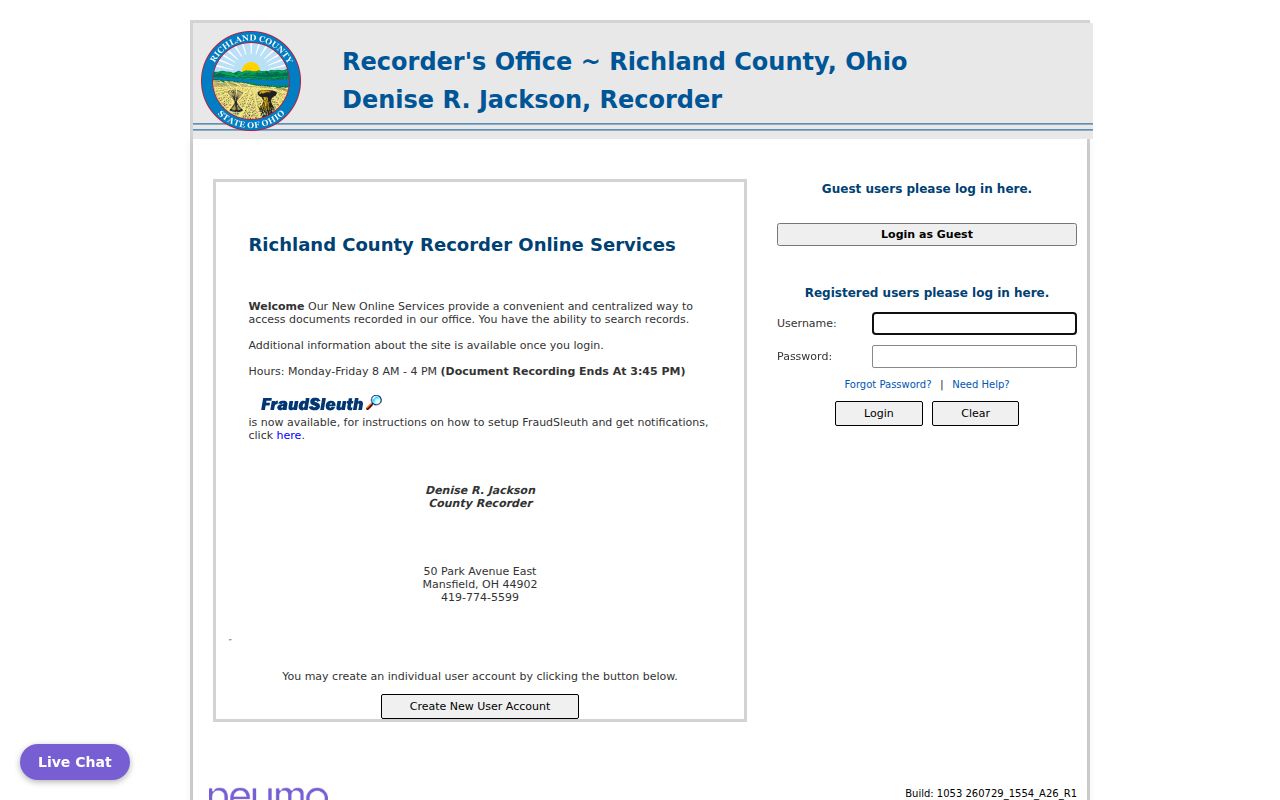
The portal supports the recent document portion of the trail. The parcel and party notes taken before searching keep a later terminal visit tied to the same property.
The Recorder has digitized deeds back to 1814 for access at its terminals. The office is at 50 Park Ave. East, Mansfield, and lists 419-774-5602; call before a long title search because research-terminal access is a counter question. The official sources found a small printing charge but did not publish its amount. Online absence should never be treated as proof that an older deed is unavailable.
Trace Mansfield Previous Residents Through Deeds
Deeds are organized around people and legal descriptions. Start with the current owner and description recorded on the Auditor card. In the current transfer, the buyer is the grantee and the seller is the grantor. The seller may be the next party to search as a grantee, revealing the earlier acquisition. A current deed sometimes cites the earlier volume and page, but that shortcut still needs a legal-description check because a parcel may have been divided or combined.
A screenshot from the Richland County Recorder accompanies the office that maintains the instrument trail for Mansfield previous residents.
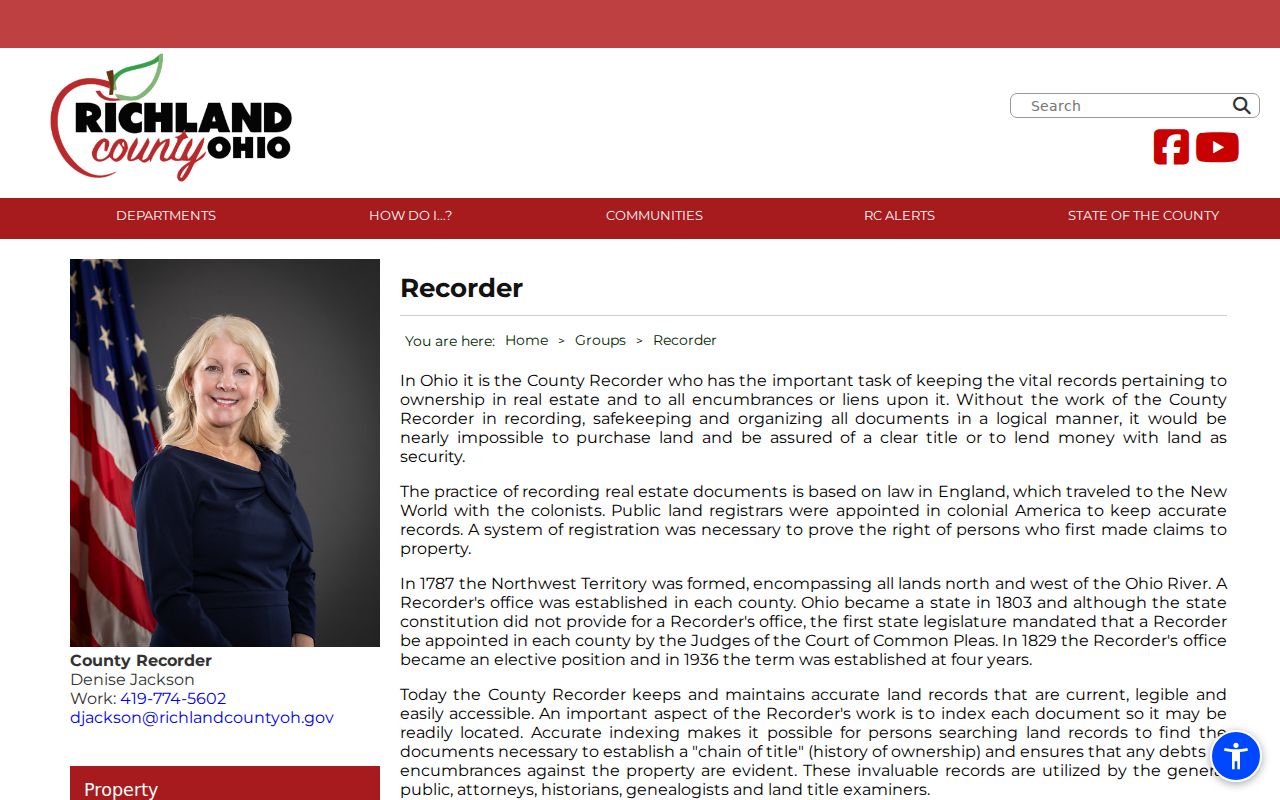
Use the Recorder image as a source cue only. The evidence comes from the actual deed or recorded instrument, its parties, its recording information, and its legal description.
- Search the Auditor card by address, then record the parcel number, situs, legal description, and displayed current owner.
- Use the owner name and document clues in CountyFusion to locate the current transfer. Preserve the document type, recording date, and image citation.
- Read the current deed for the grantor, then search that former seller as a grantee to find the earlier acquisition.
- Repeat the reversal, keeping grantor, grantee, instrument or book/page reference, and matching legal description on a chain sheet.
- At the 1989 web cutoff, take that chain sheet to the Recorder terminals for the older digitized images.
- Grantor / grantee
- The grantor conveys an interest in the document. The grantee receives that stated interest.
- Chain of title
- A dated sequence of recorded transfers for the same legal interest or parcel, checked one instrument at a time.
- Legal description
- The recorded lot, tract, subdivision, or land description that identifies property more reliably than a historic street number.
Mansfield Cross Streets Protect Address History
A matching house number alone is weak evidence. The Sherman Room’s local house-research guidance advises researchers to establish the street section and intersecting streets before attaching an old directory entry to a modern parcel. A number can disappear after demolition, subdivision, renumbering, or a move. An address search can also fail for a removed structure, which is why the parcel and legal description deserve a place beside the printed street address in every note.
For a former building, compare the deed description with an atlas, plat book, or Sanborn lot label. The Sherman Room holds an 1856 Richland County wall map, 1873 and 1896 atlases, and listed plat books from 1940 through 2001. Cross streets help test continuity, while the map and legal description help identify whether the old listing belongs to the same place. No reviewed official source established a single citywide renumbering year or conversion table, so an unexplained number shift should remain a question, not a conclusion.
Mansfield Previous Residents in Directories and Census
Directories answer the household-side question after the land trail is underway. Mansfield city directories begin in 1858, but address and street searching begins in 1894. In the address-capable years, copy the short street sequence, note the crossing streets, and find each listed head in the alphabetical part for spouse, widow, or other context. A directory lists residents, not necessarily owners, and it may omit a household. The local collections themselves are described in more depth with the Mansfield city directories.
Pair a run of directory years with the federal census rather than stretching one edition into a decade-long claim. The census names every household member from 1850 onward in the available schedules, the 1890 population census was lost, and street and house-number information begins in 1900. A directory first appearance, a later census household, and a deed transfer may line up, but each should retain its own date and citation.
- Choose a directory year from 1894 or later when the address is the starting point.
- Record the street sequence, cross streets, listed head, page, and the year’s spelling of the address.
- Check the alphabetical entry and its abbreviation key before interpreting spouse or widow notation.
- Compare the directory cluster to the nearest available census, then record what each source actually identifies.
Note: A missing directory number can reflect a vacant lot, changed address, unlisted household, or an edition problem, not an empty history.
Mansfield Sanborn Maps Place a Building
Sanborn maps place a structure in time without naming who lived inside it. Mansfield editions identified by the library include 1887, 1892, 1897, 1902, 1909, 1914, 1921, 1929, and 1929 updates to 1949. The Sherman Room also holds a 1929 map with updates to 1937, and later guidance mentions physical 1937, 1945, and 1963 map books. Ask staff which edition covers the block before relying on a map image.
Compare the footprint, lot, materials or notation to the parcel description, directory cross streets, and deed chronology. A map can show that an improvement appears between editions or that a street relationship changed. It cannot identify a resident. For date-specific work beyond the maps, Building and Codes or the relevant utility-record custodian may need a request by address and project range because the reviewed sources did not publish a complete online historic series.
Mansfield Previous Residents End With Probate Records
An obituary can supply a date, family reference, or published residence description, but it does not transfer title. The Sherman Room has Mansfield newspapers from 1823 forward with gaps and can assist with obituary or microfilm copies. Its digital-newspaper project includes more than 40,000 pages from 1823 to 1923. Keep the newspaper title, date, page, and exact name with the result, then compare the event to the Recorder chain and any relevant probate file.
For an estate lead, contact the Richland County Probate Court before visiting to identify a case number and whether the file is archived. The court is at 50 Park Ave. East, second floor, and records staff list 419-774-5583. A recorded estate instrument and an estate file can document different parts of the same event. Preserve their identifiers separately. This last check prevents a past-residents timeline from becoming a guess about family relationships or occupancy.
Lawful use. Use Mansfield house-history records for personal, family, estate, and property research. Do not use names or addresses to stalk, harass, or harm anyone.
Mansfield Previous Residents Need Separate Evidence
Keep business filings out of an address-history conclusion. The Ohio Business Services portal provides entity, filing, certificate, and statutory-agent material, but the Secretary’s guidance says it does not maintain owner or officer lists. A statutory-agent address is a business contact field, not evidence that an individual owned or lived at the Mansfield parcel. It should not be substituted for a deed, directory, census, or probate record.
A capture of the Ohio Business Services search illustrates a source that must remain separate from a Mansfield previous residents trail.

The search can lead to the underlying entity record, but it cannot establish a household history at an address. Label each result by its actual evidentiary level: recorded owner, directory-listed resident, census household member, probate event, or business filing association.